
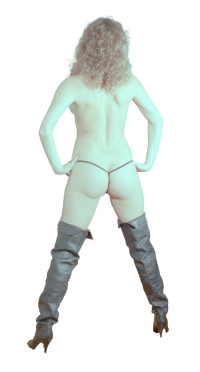
When I should be working on an erotic romance story or trying to finish one of the ones in my draft folder, I’m playing with PhotoShop. As usual, my favorite model is my lovely wife, and I’ve just finished working on a nice backshot of her in thigh-high leather boots and a black thong.
I do a fair amount of graphics design but am not too handy at editing images with Photoshop or GIMP. My experience typically involves assembling a final image for a book cover or illustration.
My go-to program is CorelDraw, which I’ve used for years and has been around forever. Most people haven’t heard of it as it’s a commercial product used by ad layout and graphic designers. Often, authors try to use graphics editing software like Photoshop, but CorelDraw is better suited for cover design.
The best way to explain the difference between CoreDraw type products and Photoshop is that Corel uses objects to assemble a final product. It’s possible to use Photoshop similarly, but Corel is designed to make it easier.
As an engineer by training, I love the nasty little details and do all of my book cover designs myself rather than farming them out. It saves me money and gives me complete control over the final output. Engineers are typically very anal about stuff, and if I come to your house, I’ll straighten all your pictures before I leave. When I go to a fast food restaurant, I will automatically straighten all the signs, printers, advertising, and anything else at the order counter.
Corel treats anything as an object or group of objects. To create a typical cover for one of my smut stories, I’ll start with an image of generally two girls. Even if there is only one girl in the story, I’ll use two girls, as two are much hotter than one. When you are capturing the image, you typically have to crop or alter the size to fit on the cover. Corel allows you to crop, enlarge, shrink, or modify the size of the image. It’s not for changing a girl’s hair from blond to brunette but just modifying the overall picture to fit the page. Remember that the image is an object or thing you can grab to reposition or adjust.
The story’s title is a string of characters, typically large and bold. This is another “object” which is placed on the cover layout. Another object will be the author’s name and possibly the story’s tagline. These all become objects to be manipulated as desired.
Hopefully, this makes sense as to what “objects” are and how a story’s cover image is a group of these objects. Once you have the cover properly formatted, CorelDraw will export the final image as an image file or PDF to be used by the publisher.
The cool part comes in when you’ve written the next story and need a new cover for it. Rather than starting from scratch, simply make a copy of the first story’s CorelDraw file. Then, edit the “objects” to correct the cover image, title, etc. Creating a new cover image often becomes a quick editing process without reinventing the wheel.
Another benefit of Corel is the ability to create precisely dimensioned output. I’ve authored and published almost twenty paperback stories, and the covers have to be a precise size in every case.
A book cover comprises three parts: the back, spine, and front. Opening a book and laying it face down illustrates how the cover image is prepared. Publishers require a single PDF file with the back, spine, and front as a single wide image. The front and back are simple and always the same size. The number of pages in the story determines the spine’s width.
Publishers will check the cover image’s width, which must be exactly the desired size. Corel allows the designer to create a correctly dimensioned image, which is difficult to accomplish without proper tools such as CorelDraw.
To create a paperback print book, I recommend QuarkXPress to generate a multipage PDF file, which the publisher will utilize to print the final book. These commercial products are not cheap, but several open-source products do similar jobs, such as Inkscape, Scribus, and GIMP. I’ll leave it to the reader to Google them if interested.
Before I go, I’d like to give a shout-out to Kinky Literature for their help and support. For authors of erotica, advertising your stories can be somewhat difficult as publishing houses often frown on porn.
Kinky Literature is a no-cost-to-the-buyer source for all the best erotic stories from your favorite authors. They make their money from referral fees when you buy from their links, but the reader pays the same price for erotic literature.
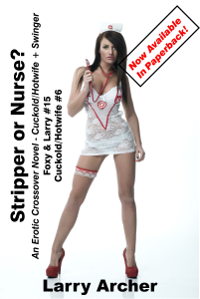
For example, today, Kinky Literature features Stripper or Nurse, which is one of my cuckold – Hotwife stories. The story is right up your alley for those who enjoy reading about wife-swapping. It’s somewhat based on Pam and Jack, our closest couple in the lifestyle. It’s a nice long story with explicit sex scenes on virtually every page.
I’m Larry Archer, a simple writer of smut stories in print, electronic, and audiobook formats. Foxy and I are swingers in real life, and I write about the things we do and see. While the Lifestyle is not for everyone, it’s been fun for us. My smut is explicit and hardcore but with a somewhat plot. My porn stories are generally positive and fun as this reflects how enjoyable swinging has been to us. If you’re interested in checking out my stories, I publish at all the typical outlets.

 Larry Archer's World (LarryArcher.blog)
Wait – that’s Foxy’s backside? Oh, you lucky…
LikeLiked by 1 person
In the flesh. My very own 80’s porn star. With curly hair she finally gave up and wears it in the big hair style that Texans everywhere love. She’s far above my pay grade!
LikeLike
“Even if there is only one girl in the story, I’ll use two girls, as two are much hotter than one. ”
Now there’s a worthwhile philosophy!
I use Corel for my covers, too, though my version is ancient. The precise dimensioning is really essential in doing print covers.
I also use Gimp for compositing and image fix up. My old Corel doesn’t deal well with PNG transparency.
(Don’t tell me to get an update. Then I’d need a Windows system. I run Corel on a Windows XP virtual machine!)
LikeLiked by 1 person
Lisabet,
I picked up a copy of CorelDraw Technical version for about $130 from one of these places that sell outdated software and that’s how I’m going to go from now own. I have a maintenance contract for CorelDraw on my primary two machines and keep them on the latest version but my development machine runs Corel that’s a couple of years old. The only software I lease is PhotoShop and Lightroom because the rental version is the only one which will read the new Canon RAW files. Pisses me off with Adobe for deliberately making that switch a couple of years ago. So it forces me to spend $10/month for LightRoom.
And speaking of two girls, that’s what is nice about writing erotica. You can have as many girls as you can imagine! F&L
LikeLike